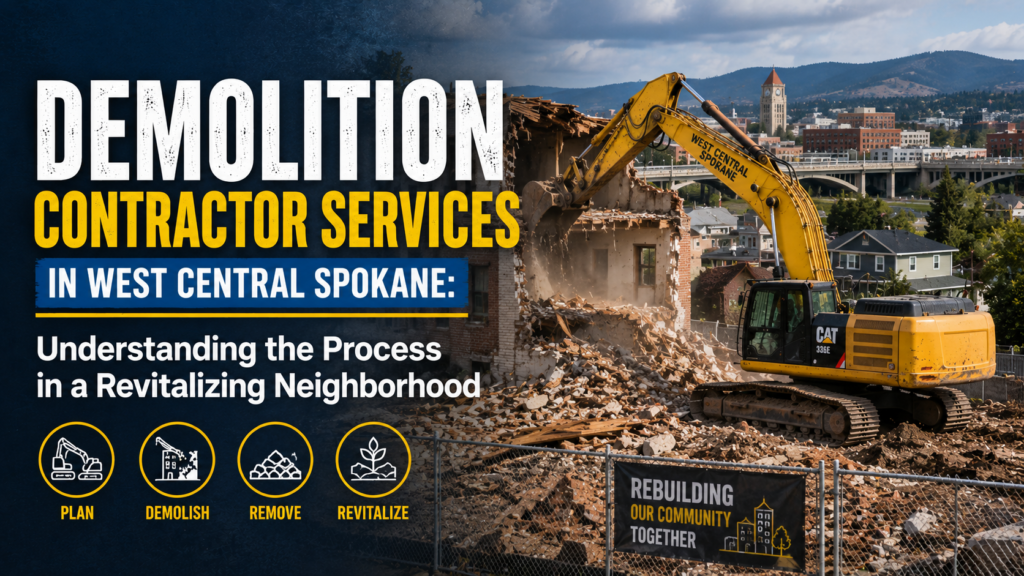
West Central is one of Spokane’s most historically significant and actively evolving neighborhoods. Situated along the north bank of the Spokane River just northwest of downtown, it encompasses a mix of historic residential structures many dating to the late nineteenth and early twentieth centuries, including the Nettleton’s Addition Historic District on Washington’s State Heritage Register and newer mixed-use development anchored by the Kendall Yards district built on the site of a former railroad yard. As West Central continues its renaissance, Demolition Contractor West Central services play an important and nuanced role in the neighborhood’s transformation.
The Character of West Central and What It Means for Demolition Work
West Central’s building stock spans more than 130 years of construction history. Many of the neighborhood’s residential structures are relatively historic, built before 1939, reflecting architectural styles ranging from Queen Anne Revival and Craftsman Bungalow to Colonial Revival and Tudor Revival. This historical character is a significant community asset West Central is home to the largest National Register Historic District in Washington State.
At the same time, the neighborhood contains structures that have deteriorated beyond practical repair, some of which represent genuine safety hazards. Demolition in this context requires careful, thoughtful contractor selection professionals who understand how to work in historically and architecturally sensitive neighborhoods, coordinate with city permitting and potentially historic preservation review, and execute demolition precisely enough to avoid damaging adjacent structures that may be historically significant.
Residential Demolition in West Central
Residential demolition is the most common type of demolition work in West Central. Projects range from the removal of detached garages, accessory structures, and sheds to full residential teardowns of homes that have suffered fire damage, structural failure, or extensive deterioration.
The process for residential demolition in Spokane’s West Central neighborhood follows a defined sequence:
- Pre-demolition inspection: The structure is assessed for construction type, condition, and the presence of hazardous materials including asbestos and lead-based paint, both of which are common in West Central’s older housing stock.
- Asbestos and lead survey: Washington State regulations require that any residential structure built before 1980 be surveyed for asbestos-containing materials before demolition. Asbestos abatement by a licensed contractor must be completed before the structure is demolished.
- Utility disconnection: Spokane Utilities and applicable private utilities must disconnect all service lines. City of Spokane permit applications for demolition require utility disconnection confirmation.
- Demolition permit: The City of Spokane requires a demolition permit before structural removal can begin. Applications for demolition permits are forwarded to the neighborhood council the West Central Neighborhood Council for review and comment under Spokane’s Neighborhood Notice ordinance.
- Demolition execution: The structure is systematically dismantled using appropriate equipment for the site’s urban context. In West Central, where lots are often narrow and adjacent to neighboring homes, precision matters.
- Debris removal and site cleanup: All debris is removed and properly disposed of or recycled. The site is graded and stabilized.
Commercial and Mixed-Use Demolition in West Central
West Central’s commercial corridors and the ongoing Kendall Yards development area have seen significant commercial and mixed-use demolition activity as the neighborhood rebuilds. The former Kendall Rail Yard, for example, required extensive industrial site remediation and demolition before the current mixed-use district could be developed.
Commercial demolition in West Central involves the same fundamental sequence as residential work survey, abatement, utility disconnection, permitting, execution, and site restoration but at a larger scale and with more complex regulatory coordination. Washington State’s Department of Labor and Industries oversees asbestos abatement work, and the City of Spokane’s Building and Planning Department reviews demolition permits for commercial structures.
Environmental Considerations in West Central Demolition Projects
West Central’s history as a railroad-era neighborhood introduces environmental considerations that are relevant to demolition projects in specific areas. Former rail corridors can carry soil contamination from historic operations. Properties adjacent to the Spokane River may be subject to additional environmental review requirements. Lead soil contamination from exterior paint on older residential structures is a recognized concern across Spokane’s historic neighborhoods.
Responsible demolition contractors working in West Central are familiar with these considerations and plan their work accordingly using appropriate containment during demolition of lead-painted structures, coordinating with environmental consultants when site history suggests potential contamination, and following Washington State Department of Ecology guidelines for demolition waste characterization and disposal.
Working Respectfully in an Urban Neighborhood
West Central is an occupied, active neighborhood. Demolition work here happens among residents, businesses, and community organizations that care deeply about the quality of work happening in their area. Professional demolition contractors operating in West Central respect this reality through:
- Minimizing demolition hours to standard working hours except in approved circumstances.
- Controlling dust, noise, and vibration to the greatest extent practical.
- Maintaining clean, secured sites throughout the project duration.
- Communicating with immediate neighbors before and during work.
- Removing debris promptly rather than allowing it to accumulate on-site.
These practices are not just courtesies they are requirements under Spokane’s municipal code and the professional standards that distinguish responsible demolition contractors from those who treat urban work as they would a remote industrial site.
Conclusion
Demolition contractor services in West Central Spokane operate at the intersection of urban revitalization, historic preservation awareness, regulatory compliance, and community responsibility. As one of Spokane’s most actively developing neighborhoods, West Central continues to evolve and thoughtful, skilled demolition work is part of what makes that evolution possible, clearing space for new development while respecting the history and community character that make the neighborhood worth investing in.